How Website AI Chatbots Reduce Customer Support Cost

Amanda Lee
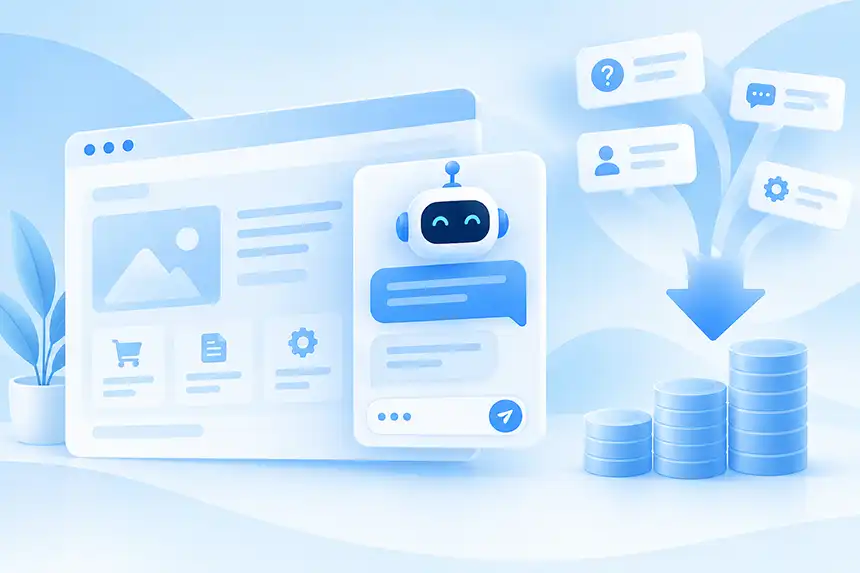
Customer support is expensive for a simple reason: as businesses gain more customers, they usually receive more questions. More questions mean more emails, support tickets, live chats, and phone calls. Eventually, growing customer demand requires a larger support team.
But many of those interactions have something in common: The answer was already on the website.
A customer couldn't find the return policy. A prospect wasn't sure whether a product was compatible. Someone needed help configuring a feature. A subscriber wanted to understand how to change plans.
The information existed. The customer simply couldn't find it quickly enough. That's where website AI chatbots can fundamentally change the economics of customer support.
Instead of waiting until a customer opens a ticket, a website AI chatbot can answer questions directly at the point where they arise. Visitors can ask questions in natural language and receive answers based on your website, documentation, FAQs, and other business content.
The result isn't simply cheaper customer support. It's the opportunity to prevent many routine support interactions from being necessary in the first place.
What Is a Website AI Chatbot?
A website AI chatbot is an AI-powered conversational interface embedded directly into a business website. Unlike traditional scripted chatbots, modern website AI chatbots use generative AI to understand natural-language questions and respond conversationally.
They can typically learn from sources such as:
- Website pages
- Product information
- Documentation
- FAQs
- Help articles
- Policies
- PDFs and documents
- Knowledge bases
- Other business content
Instead of requiring a visitor to navigate the website to find an answer, the AI chatbot provides another interface to the same information. The visitor simply asks.
For example: "Does this product work with an iPhone 17?"
Or: "Can I change my subscription later?"
Or: "What's your return policy if I've already opened the package?"
A well-trained website AI chatbot can find the relevant information and provide an immediate answer without involving the support team. That's what makes website AI particularly interesting from a cost perspective.
The Website Is Already Part of Your Customer Support Operation
Businesses don't always think of their website as customer support infrastructure. But it is.
Why do companies publish FAQs? Why create product documentation? Why maintain knowledge bases? Why publish return policies, installation instructions, compatibility charts, account information, and troubleshooting guides? Because customers need answers.
The website is already intended to provide many of those answers without requiring an employee. The problem is that traditional websites make customers find the information themselves.
That means navigating menus, guessing search terms, scanning pages, opening documentation, and figuring out where the company decided to put the answer. When customers can't find it, or simply don't want to spend time looking, they contact support.
At that point, an information-discovery problem becomes a support cost.
Website AI chatbots attack that problem directly.
1. Website AI Chatbots Answer Questions Before They Become Tickets
Traditional support automation generally begins once someone enters the support process.
The customer opens the help center. They start a support chat. They send an email. They submit a ticket. Then the company tries to resolve that interaction efficiently.
A website AI chatbot can intervene much earlier.
Imagine someone browsing a product page who wonders: "Will this replacement part work with the model I bought in 2024?"
Without conversational AI, that visitor might search the website, open product documentation, contact support, or simply leave. With an AI chatbot embedded on the website, they can ask the question immediately.
If the answer exists in the company's content, the chatbot can provide it. The result is:
- No ticket
- No email
- No support queue
- No employee required
That's an important difference between automating customer support and preventing unnecessary support interactions.
The cheapest support ticket isn't one handled efficiently. It's one that never needed to exist.
2. Website AI Chatbots Reduce Repetitive Support Questions
Every business has questions it answers repeatedly.
For an e-commerce business:
- "Do you ship internationally?"
- "What's your return policy?"
- "When will my order arrive?"
For a software company:
- "Do you integrate with WooCommerce?"
- "How do I reset my password?"
- "What's included in the Business plan?"
For a home services business:
- "What areas do you serve?"
- "Are you open on Saturdays?"
- "How do I schedule an appointment?"
These questions don't usually require human judgment. They require information. If that information already exists on the website or in the company's support content, having an employee repeatedly retrieve and restate it is an inefficient use of human time.
A website AI chatbot can handle many of those questions automatically. Multiply that across hundreds or thousands of website conversations and the potential reduction in support workload becomes significant.
3. Website AI Makes Existing Content Easier to Use
Businesses already spend money creating customer-support content.
They publish:
- FAQs
- Help articles
- Product manuals
- Documentation
- Knowledge bases
- Policies
- Tutorials
- Troubleshooting guides
The challenge is getting customers to use it. A 100-page knowledge base might contain every answer a customer needs. That doesn't mean the customer knows which article contains the answer.
Traditional website search helps, but it still requires customers to translate their question into keywords and evaluate a list of results. A website AI chatbot changes the interface. The AI can interpret the question, retrieve relevant information, and explain it conversationally.
That makes existing support content more accessible, and increases the return on the content you've already created.
4. Website AI Chatbots Provide 24/7 First-Line Support
Your website doesn't close when your support team goes home. Customers may be researching products, configuring software, reading documentation, or troubleshooting problems at any hour.
Providing human support around the clock can be expensive. It may require multiple shifts, outsourced support, or employees across different geographic regions.
A website AI chatbot can provide a first layer of customer support continuously. If someone asks a straightforward question at 2:00 AM, they don't necessarily need to wait until the support team arrives the next morning. If the information is available, the AI can answer immediately. And if the issue genuinely requires a human, the chatbot can collect information and prepare the conversation for follow-up.
AI doesn't have to replace 24/7 human support. For many businesses, it can eliminate the need to provide human coverage simply to answer questions that could have been resolved automatically.
5. Website AI Chatbots Let Support Teams Focus on Harder Problems
Not every customer question should be automated.
Some situations require:
- Complex troubleshooting
- Human judgment
- Policy exceptions
- Investigation
- Negotiation
- Empathy
- Specialized expertise
Those are exactly the interactions where support employees provide the most value. Website AI chatbots create a filtering layer. The AI handles common information-driven questions directly on the website. The support team handles the problems where a person actually makes a difference. The result doesn't necessarily have to be fewer support employees.
It can mean more customers supported by the same team, which is particularly important for growing businesses.
6. Website AI Can Reduce Support Costs as Traffic Grows
Traditional support operations often scale approximately like this: More customers → more questions → more tickets → more support employees
Website AI introduces another possibility: More customers → more AI conversations → only complex issues become support tickets
That changes the scaling equation. Imagine a business doubles its website traffic and customer base. Under a traditional model, support volume might rise significantly along with it.
But if a website AI chatbot handles a large portion of repetitive questions before they reach the support organization, ticket volume doesn't necessarily need to increase at the same rate. Support headcount may still grow. But it doesn't have to grow linearly with every increase in customer volume.
That's where AI can produce significant long-term economic value.
7. Website AI Chatbots Can Handle Traffic Spikes
Support demand isn't always predictable. A product launch, holiday promotion, service disruption, pricing change, or major announcement can suddenly produce a large number of customer questions. Human support teams have natural capacity limits.
AI does not have the same one-to-one relationship between conversations and employees. A website AI chatbot can handle many conversations simultaneously. This makes AI particularly useful when a traffic spike produces large numbers of similar questions.
Instead of temporarily staffing the support organization around peak demand, AI can absorb a significant portion of repetitive inquiry volume.
8. Website AI Can Improve Human Escalations
Eventually, a customer will ask something the chatbot can't (or shouldn't) answer. That's not a failure.
The important question is what happens next. A poor chatbot traps the customer in an endless loop. A better website AI chatbot recognizes that human assistance is appropriate and provides a path forward. It may also collect useful information before escalating.
Instead of the support team receiving: "I need help."
They might receive the conversation showing that:
- The customer is configuring a 3rd party tool integration
- They followed the setup instructions
- They're receiving an authentication error
- The AI couldn't resolve the issue
- The customer's contact information has already been collected
The human employee starts with context. Even when the AI doesn't resolve the issue itself, it can reduce the amount of human time required to understand and route the problem.
9. Website AI Conversations Reveal Why Customers Contact Support
One of the most overlooked benefits of a website AI chatbot is what you learn from the conversations. Visitors ask the AI what they actually want to know. That creates a valuable dataset.
Suppose 200 visitors ask: "Does this work outside the United States?"
But your website doesn't clearly answer the question. The chatbot may struggle.
At first, that looks like an AI problem. But it isn't. It's a website content gap.
The conversation has revealed information customers need that your website doesn't provide clearly enough. Now you can fix the underlying content.
Over time, website AI can therefore reduce support demand in two ways. It answers questions directly. And it helps you identify why those questions needed to be asked.
10. Website AI Can Support Sales and Customer Service at the Same Time
There's another economic benefit to putting AI directly on the website.
Not every question fits neatly into "sales" or "support."
Consider: "Does the Professional plan support multiple locations?"
Is that a support question? Maybe.
But if the visitor hasn't purchased yet, it's also a sales question.
Or: "Will this replacement part work with my existing system?"
Again, it could be support. It could also determine whether someone makes a purchase.
Traditional organizations separate these functions. The visitor doesn't care. They simply want an answer.
A website AI chatbot can support both types of conversations from the same interface. That means the investment isn't necessarily limited to reducing customer support costs.
The same AI experience can also improve product discovery, engage prospects, capture leads, and help visitors make purchasing decisions.
How Much Can a Website AI Chatbot Reduce Support Costs?
There's no universal percentage. The potential savings depend heavily on the business.
Important factors include:
- Monthly support volume
- Website traffic
- Percentage of repetitive questions
- Quality of website and support content
- Customer adoption of the chatbot
- AI answer accuracy
- AI resolution rate
- Human escalation rate
- Cost per support interaction
- Cost of the AI platform
A business receiving a small number of highly complex technical questions has a very different automation opportunity from an ecommerce company receiving thousands of repetitive product and policy questions.
The best approach is to model the economics using your own support data.
A Simple Website AI Chatbot ROI Model
Suppose a business receives 10,000 support interactions per month.
Assume that 40% are repetitive, information-driven questions whose answers already exist in website or support content. That's: 4,000 potentially automatable interactions.
Suppose a website AI chatbot successfully resolves 75% of those without human intervention. That's: 3,000 human support interactions avoided per month.
If the fully loaded average cost of a human support interaction is $5: 3,000 × $5 = $15,000 in avoided monthly support workload.
If the AI chatbot costs $1,000 per month, the simplified gross difference would be: $14,000 per month.
Real-world ROI calculations should obviously include implementation, maintenance, escalation rates, AI usage, and other costs. But the basic framework is useful: Support volume × automatable percentage × AI resolution rate × cost per human interaction
Then compare the result with the total cost of the website AI platform.
Don't Optimize Only for Ticket Deflection
There's a danger in measuring website AI purely by how many customers it prevents from contacting your support team.
Imagine a chatbot that "deflects" a customer by repeatedly providing an incorrect answer until the customer gives up. Technically, perhaps no ticket was created. That's not success.
Useful metrics include:
- AI resolution rate
- Answer accuracy
- Human escalation rate
- Customer satisfaction
- Average resolution time
- Cost per resolution
- Repeat contacts
- Support ticket volume
- Conversation feedback
The objective isn't to make it difficult for customers to reach people. It's to give customers the fastest appropriate path to a correct answer.
Sometimes that's AI. Sometimes it's a person. The system needs to know the difference.
Website AI Should Be the First Line of Support, Not a Barrier to Support
The wrong AI strategy is easy to imagine: Deploy a chatbot everywhere, hide the contact information, make escalation difficult, and celebrate every interaction that doesn't reach a human.
Customers hate that experience. Website AI should do the opposite. It should remove friction when the answer is straightforward and make human assistance easier when it isn't.
That's why human escalation should be a core capability of any website AI chatbot used for customer support. The AI shouldn't exist to keep customers away from employees. It should exist to ensure employees spend their time on the customers who actually need them.
Start With Your Website
Businesses don't need to replace their help desk or redesign their entire support organization to begin using AI.
Start with the website. Look at the questions your support team receives repeatedly. Then ask: Does the answer already exist somewhere on our website or in our business content?
If the answer is yes, that's a strong candidate for website AI. Your business has probably already invested years creating the information customers need.
Website AI simply gives them a much easier way to access it. Instead of searching your website, they can ask it.
Reduce Customer Support Costs With CrafterQ
CrafterQ turns your website and business content into a conversational AI experience that can become the first line of customer support.
Train your AI agent on your website, documentation, FAQs, and other business content. Visitors can then ask questions conversationally and receive immediate answers based on the information you've provided.
When AI isn't enough, CrafterQ Actions can escalate the conversation to a human and preserve the context needed to continue helping the customer. And because the same website AI agent can support customer service, sales, product discovery, and lead generation, its value doesn't have to stop at the support desk.
Don't just make support tickets cheaper to process. Give customers answers before they need to create one.
Start reducing your support costs by signing up for a free CrafterQ AI account today.