Website AI Agents: The Complete Guide for Business Leaders

Amanda Jones
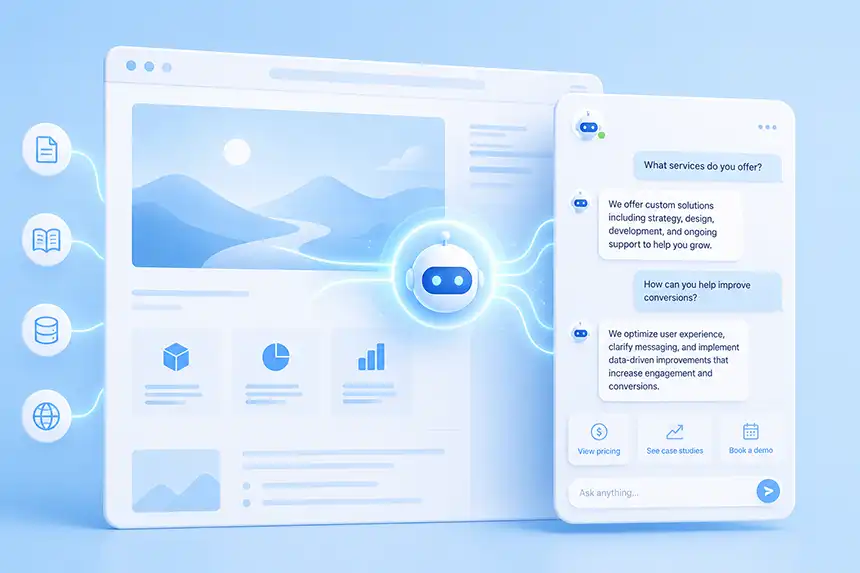
TL;DR The Web is evolving from "browsing / searching" to "conversing". Your website needs to keep up. Which is why your website needs an AI agent that engages, sells, and supports your customer with accurate, engaging and on-brand conversational experiences.
For more than 30 years, websites have been built around a simple idea: users browse pages to find information.
- Need a product? Browse.
- Need support? Browse.
- Need pricing? Browse.
- Need documentation? Browse.
The burden has always been on the visitor to navigate menus, search through pages, and piece together answers for themselves. But user expectations are changing.
Thanks to ChatGPT, Gemini, Claude, and other AI assistants, people are becoming accustomed to asking questions and receiving immediate answers. Instead of hunting through websites, they increasingly expect websites to simply tell them what they need to know.
In other words, the web is evolving from:
Browsing → Searching → Conversing
This shift is creating a new category of technology: Website AI Agents.
In this guide, we'll explain what Website AI Agents are, how they work, why businesses are adopting them, and how they are transforming customer engagement, sales, and support.
What Is a Website AI Agent?
A website AI agent is an AI-powered assistant that lives on your website and interacts with visitors using natural language.
Unlike traditional chatbots that rely on rigid decision trees and pre-defined scripts, modern AI agents understand questions, retrieve relevant information, and generate conversational responses based on your website content and knowledge sources.
Think of a Website AI Agent as a knowledgeable digital employee that can:
- Answer visitor questions
- Recommend products and services
- Guide users to relevant content
- Generate leads
- Qualify prospects
- Provide customer support
- Help users complete tasks
Most importantly, Website AI Agents are available 24/7 and can engage every visitor who arrives on your website.
Get Started Today: Launch Your Website AI Agent For Free
Why Traditional Websites Are No Longer Enough
Most websites suffer from the same problem. Visitors arrive with a specific question. They cannot quickly find the answer. They leave.
This happens thousands of times every day across the web.
Research consistently shows that more than half of website visitors leave without taking any meaningful action. The problem is not necessarily the quality of the content. The problem is the experience.
Traditional websites force visitors to navigate information structures that make sense to the organization rather than the user.
Visitors must decide:
- Which menu to click
- Which page to visit
- Which keyword to search
- Which document contains the answer
A website AI agent removes this friction. Instead of searching for answers, visitors simply ask questions.
The experience becomes conversational rather than navigational.
Learn More: Turn Your Website Into a Conversational AI Experience
How Website AI Agents Work
Modern website AI agents are typically powered by large language models (LLMs) combined with retrieval systems that ground responses in your content.
The process generally works like this:
Step 1: Train the Agent
The agent is connected to content sources such as:
- Website pages
- Knowledge bases
- Product documentation
- PDFs
- FAQs
- Help center articles
- Internal knowledge repositories
The content is indexed, chunked for AI retrieval, and lives in your AI agent's "brain" ready to interact with customers.
Step 2: Configure the Agent
Next, you configure how the agent should behave.
This includes defining its:
- Name and role
- Brand personality
- Tone of voice
- Conversation style
- Guardrails
- Escalation rules
- Approved topics
- Response boundaries
This step is important because a Website AI Agent should not sound generic. It should reflect your business, your brand, and the kind of customer experience you want to deliver.
For example, a luxury hotel may want an agent that feels polished, warm, and concierge-like. A software company may want an agent that is precise, technical, and direct. A local service business may want an agent that feels friendly, helpful, and practical. A motorcycle club may want a fun and sarcastic agent to poke at club members.
The goal is to make the agent feel like a natural extension of your website and your brand.
Step 3: User Asks a Question
A visitor asks a question such as:
"Which pricing plan is best for a team of five?"
or
"How do I integrate your software with Microsoft 365?"
Step 4: Content Retrieval
The AI agent searches the its "brain" and other knowledge sources for relevant information. This retrieval step ensures responses are grounded in your content rather than relying solely on the AI model's general knowledge.
Step 5: Response Generation
The AI model generates a natural language response using the retrieved information. The result is a conversational answer that is both accurate and easy to understand.
Step 6: Monitor and Optimize Your Agent
Launching your AI agent is just the beginning.
One of the most valuable aspects of a Website AI Agent is the visibility it provides into what visitors are actually asking and where they may be struggling to find information.
A website AI agent platform should provide analytics and conversation logs that allow you to monitor:
- Common visitor questions
- Frequently discussed topics
- Unanswered questions
- Knowledge gaps
- Customer pain points
- Lead generation opportunities
These insights can be used to improve both the agent and the underlying website content.
For example, if visitors repeatedly ask questions that your website does not answer well, you can create new content, update existing pages, or add additional knowledge sources to improve future responses.
Over time, this creates a continuous feedback loop:
Visitors ask questions → Insights are gathered → Content is improved → The agent becomes smarter → Customer experiences improve
The most successful organizations treat their website AI agent as a living digital employee that is continuously trained, refined, and optimized based on real customer interactions.
Website AI Agents vs Traditional Chatbots
Many people use the terms interchangeably, but they are fundamentally different technologies.
Traditional Chatbots
Traditional chatbots typically:
- Follow scripted conversation paths
- Require extensive manual setup
- Break when users ask unexpected questions
- Offer limited flexibility
- Depend on predefined decision trees
Website AI Agents
Website AI Agents:
- Understand natural language
- Handle open-ended questions
- Learn from your content
- Adapt to different conversations
- Deliver more human-like interactions
Traditional chatbots attempt to control the conversation. AI agents participate in the conversation.
The Business Benefits of Website AI Agents
Organizations are adopting website AI agents for three primary reasons:
1. Improve Visitor Engagement
Most websites are passive. They display information but do not actively engage visitors. As a result, bounce rates exceed 50% for most business websites.
Website AI Agents create interactive experiences that encourage users to ask questions and continue exploring.
The result can include:
- Increased time on site
- Reduced bounce rates
- Higher engagement levels
- Improved user satisfaction
Read Case Study: How Uni Marketing Agency Increased Inbound Leads by 35%
2. Increase Conversions
Many buyers leave websites because they cannot quickly find the information they need to make a decision.
An AI agent trained on your content can answer questions accurately in real time, helping prospects move through the buying process more efficiently.
Examples include:
- Product recommendations
- Pricing explanations
- Feature comparisons
- Qualification questions
- Scheduling demos
The agent becomes a digital sales assistant available around the clock.
Read Case Study: How BuyRailings Increased E-Commerce Sales 12% with an AI Shopping Assistant
3. Automate Customer Support
Customer support teams often answer the same questions repeatedly.
Website AI Agents can handle many common inquiries automatically, including:
- Account questions
- Product usage guidance
- Documentation assistance
- Troubleshooting requests
- Policy and process questions
This reduces support costs while improving response times.
Common Website AI Agent Use Cases
Small and Medium-Sized Businesses (SMBs)
Most SMBs cannot afford dedicated sales and support teams available around the clock. And like most businesses, their website visitors usually bounce within 10 seconds without getting the answers they want or taking any action.
Website AI agents allow small- to mid-size organizations to deliver enterprise-grade customer experiences without increasing headcount.
Common use cases include:
- Answering frequently asked questions
- Capturing and qualifying leads
- Helping visitors find products and services
- Explaining pricing and service options
- Providing after-hours support
- Directing users to the right resources
The result is a website that works more like a digital employee than a digital brochure.
E-Commerce Stores
- Product discovery
- Product recommendations
- Shopping assistance
- Order status questions
- Return and refund guidance
- Upselling and cross-selling opportunities
Rather than forcing shoppers to browse catalogs, AI agents can help customers find exactly what they need through conversation.
SaaS Companies
- Product guidance
- Documentation support
- Trial-to-paid conversion assistance
- Customer onboarding
- Feature discovery
- Technical support
Professional Services
- Lead qualification
- Service recommendations
- Appointment scheduling
- Frequently asked questions
- Proposal request assistance
- Client onboarding support
Hospitality and Travel
Travelers often have specific questions before making a booking. A Website AI Agent can provide immediate answers and help reduce booking friction.
Common use cases include:
- Room and accommodation recommendations
- Booking assistance
- Local attraction recommendations
- Amenities and service questions
- Event and conference information
- Transportation and logistics guidance
Hotels, resorts, tourism organizations, cruise operators, and travel companies can all use AI agents to improve guest experiences and increase direct bookings.
Healthcare Organizations
- Patient education
- Provider search assistance
- Benefits information
- Service navigation
- Location and scheduling questions
- General support inquiries
Educational Institutions
- Admissions support
- Program recommendations
- Student services
- Financial aid questions
- Campus information
- Application guidance
Virtually any organization in any industry can benefit from a conversational layer.
Read more: Website AI Agent Industry Solutions
What to Look for in a Website AI Agent Platform
Not all AI agent platforms are created equal. When evaluating solutions, consider the following capabilities:
Content Accuracy
- Can the platform ground responses in your content?
- Accurate retrieval is essential for reducing hallucinations.
Content Scale
- Can it handle large websites, documentation portals, and extensive knowledge bases?
- Does it respond quickly at all times?
Ease of Training
- How quickly can new content be added?
- Can the platform automatically retrain when content changes?
Analytics
- Can you see what users are asking?
- Can you identify content gaps and new opportunities?
Deployment Flexibility
- Can the agent be embedded into your existing website without major development effort?
- Does it work with any CMS?
Security and Compliance
- Does the platform provide the security, privacy, and governance features your organization requires?
- Does it meet industry standards including SOC 2 compliance?
The Hidden Benefit: Discovering Content Gaps
One of the most valuable benefits of website AI agents is often overlooked.
They reveal what visitors actually want to know, and what's missing in your website content architecture. Every conversation becomes a source of customer intelligence.
Organizations can analyze:
- Frequently asked questions
- Missing content
- Product confusion
- Sales objections
- Documentation weaknesses
This feedback loop helps teams continuously improve both their content and customer experience.
In many cases, the insights generated by the AI agent become as valuable as the conversations themselves.
The Future of the Conversational Web
The rise of AI is changing how people interact with information. Users increasingly expect answers rather than navigation.
Conversations rather than searches. Assistance rather than exploration.
This does not mean websites are disappearing. It means websites are evolving.
- Content remains critical.
- Pages remain important.
- Documentation still matters.
But increasingly, visitors will access that information through conversational interfaces rather than traditional navigation structures.
The organizations that embrace this shift early will create more engaging customer experiences, generate more leads, provide better support, and gain a competitive advantage.
Summary
The web is entering a new era. For decades, websites have been built around browsing. Search improved the experience, but users still had to find their own answers.
Website AI agents represent the next evolution.
By combining AI with your organization's content and expertise, they transform static websites into conversational experiences that engage, guide, and support users in real time.
The future of the web is conversational.
Book a Demo
Get started transforming your website into a conversational AI experience by booking a custom demo today.